Thanks to the conservation efforts of several area farmers, the amount of algae-producing phosphorus flowing into the Yahara watershed due to farm runoff has decreased over the years.
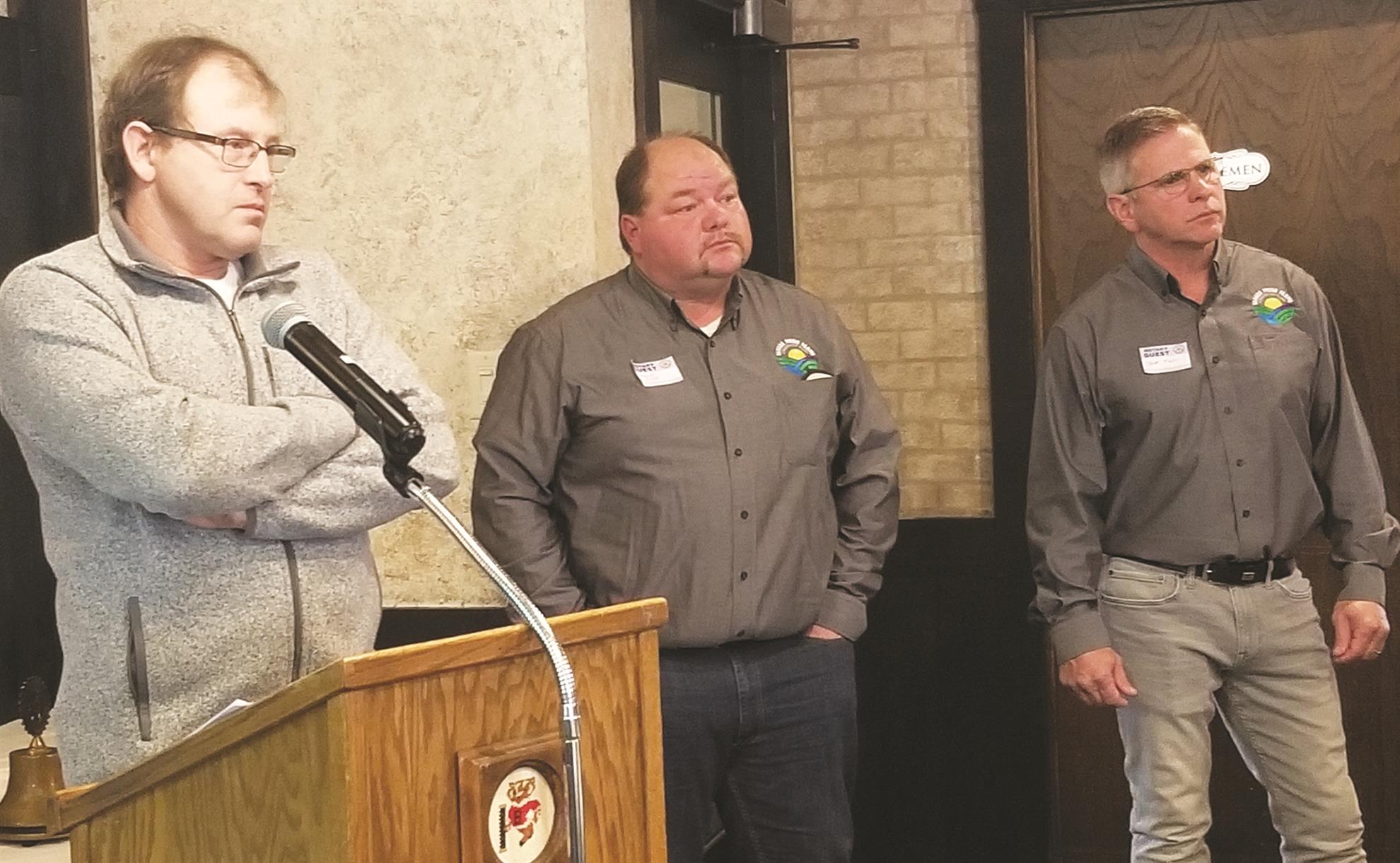
Three farmers, two from Vienna and another from Springfield, spoke to the Waunakee Rotary Club Jan. 30 about how their participation in Yahara Pride Farms has reduced the impact of agricultural operations on our waters.
Yahara Pride Farms is a farmer-led nonprofit working to improve soil and water quality in the Yahara watershed, which covers the entire Madison area, said Scott Maier of Maier Farms in Vienna.
“Every bit of water that comes out the sky either infiltrates the ground or runs to these lakes,” Scott said.
Yahara Farms has contractors and offers cost-share programs to help with the costs of conservation practices. It also offers certification and does educational outreach. That includes an annual report to show the progress made.
Funding come from a number of different of diverse supporters comprising ag and environmental groups.
Scott said Yahara Pride Farms encourages farmers to be environmentally sustainable and rewards them for their efforts.
The organization always strives to improve.
“With the water events we’ve had, it’s something we’re always trying to push forward,” he said.
Yahara Pride also tries to convey regulations to farmers and to earn trust from the public and government partners.
The watershed has about 41 farms, including beef and dairy farms, and about 35,000 acres of farmland in the watershed.
The cost-share program provides a baseline, tracking what is going on in the fields. If a cover crop is put in and reduces the phosphorous leaving the field, it is tracked. About 10,000 acres were planted with cover crops receiving no cost share. As a result of the program, 22,097 pounds of phosphorus was prevented from moving from the field into the watershed. Scott noted that one pound of phosphorus in the lakes can equate to 500-600 pounds of blue-green algae.
Cover crops also can provide feed and prevent soil erosion.
Chuck Ripp of Ripp Valley Dairy said when the farmers started the program, they knew manure on the ground contributed to the problem. He and others understood that injecting manure directly into the soil would mean less running into the watershed. The idea was to purchase a system to rent out to other farmers.
The system he uses allows for less compaction of the soil, as that compaction facilitates runoff.
Chuck said he and others enjoy seeing the reports showing the amount of phosphorous staying in the fields as a result.
Jeff Endres of Berry Ridge in Springfield spoke about composting. While liquid manure, which is 96 percent water, is pumped to the fields, bedding pack manure from the straw heifers lay on can be composted. The heating process kills all bacteria in the pathogens, creating a more nutrient dense fertilizer to apply to the crops during the spring.
Jeff noted that these conservation techniques are being developed by farmers themselves as they work to be good stewards of the land.
The Yahara Pride Farms talk followed a lunch at Rex’s Innkeeper, and Jeff reminded all that everything on their plates was grown.
“Every one of us has a responsibilty… because we are out there working with the land, taking all the risks of the weather on our shoulders… and trying to do the best job we can to keep our waterways clear but also give you a product that’s far better than anywhere else in world,” Jeff said. “Remember that when you sit down to the table.”
*******
Other News:
The Rotary Club will vote for its next board of directors next week. Ross Mauer is running for president elect, and Ann Becker is running for a director’s position.
Guests: Chuck Ripp, Scott Maier, Jeff Endres and Maria Woldt, speakers.
Visiting Rotarians: None.
Birthdays: Feb. 11, Phil Willems.
Anniversaries: None.
Programs: Feb. 6, Gregory Lee Renz, author of “Beneath the Flames”; Feb. 13, Club Assembly, Jennifer Hurley Classification Talk; Feb. 20, David Hogg, Monarch butterflies; Feb. 27, Todd Schmidt, state of the village.
Greeters: Feb. 6, Robert Lenz and Ross Maurer; Feb. 13, David May and Mark McFarland; Feb. 20, Gordon Meicher and Dan Miller; Feb. 27, Ed Niebuhr and George Ohlendorf.
